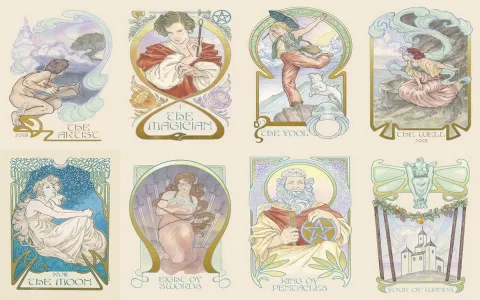

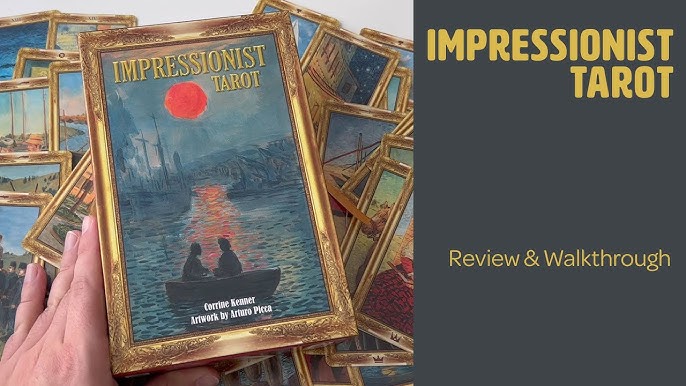
Man, let me tell you about this Impressionists Tarot Deck. I grabbed it a while back, probably just because the art looked real pretty. You know how it is, sometimes you just see something and you gotta have it. I wasn’t really looking for a new deck, had a few already, but those soft colors and blurred edges just drew me in. I ordered it online, waited a few days, and when that package finally landed on my doorstep, I ripped it open.
First thing I did was pull out the box, admiring the artwork. It felt good in my hands, a bit glossy. I cracked it open, and there they were, a whole stack of cards. The size was decent, shuffled ’em a bit, just to get a feel for the stock. Not too flimsy, not too thick. Just right. But then I actually started looking at the cards, one by one. That’s when the real work started.
I’m used to the RWS system, you know? All those clear symbols, the guy hanging upside down, the two swords, the cups, the pentacles – you see it, you get it. But these Impressionist cards? Nah, not so much. They were beautiful, absolutely stunning. Each one was like a tiny painting, like something out of a museum. But the direct symbolism? It was often missing, or at least, not obvious to my tired old eyes. The Fool wasn’t a dude walking off a cliff with a dog; it was a figure in a field, light hitting them just so. The High Priestess wasn’t sitting between pillars; it was a woman in deep thought, shadows playing around her. It was a whole different vibe.
I knew right then and there this wasn’t gonna be a quick flip-through. This was a project. So, I grabbed a new notebook, one of those cheap ones with a spiral binding, and a pen. I told myself, “Alright, we’re gonna do this. We’re gonna figure out what these cards are trying to say.”
My process was pretty straightforward, but it took time. Weeks, even months, chipping away at it.
My Exploration Process:
- First Pass – Just Looking: I’d go through the deck, card by card, just staring at each one for a good minute or two. No book, no internet, just me and the card. What did I feel when I looked at it? What colors stood out? What emotions did the scene evoke? I’d jot down keywords in my notebook. Things like “peaceful,” “confused,” “dreamy,” “heavy,” “hopeful.” This helped me build a baseline, a raw, gut reaction.
- Connecting to RWS – My Old Friend: After that initial emotional download, I’d bring in my old RWS deck or an app. I’d pull out the corresponding RWS card and lay it next to the Impressionist one. I’d try to find connections. “Okay, the RWS Three of Swords is about heartbreak, betrayal. This Impressionist card shows a solitary figure with storm clouds gathering. Can I see the pain there? The isolation?” Sometimes it was a stretch, other times, a little spark would go off. I wrote all this down.
- The Little White Book (LWB) – A Starting Point: Then, and only then, I’d crack open the small booklet that came with the deck. Usually, these things are pretty thin, right? Just a few lines per card. But for this deck, those few lines were gold. They often pointed to the specific artist or painting that inspired the card, or gave a hint about the mood. It filled in some of the blanks that my RWS comparison might have missed. I added these insights to my notes.
- Journaling and Pulling Cards: Once I had a few cards I felt I knew a bit, I started doing simple single-card pulls each morning. Just asking, “What should I focus on today?” or “What energy is coming my way?” I wouldn’t even necessarily look at the LWB right away. I’d just let the image speak, then later, compare it to my growing notes. It was like having a quiet conversation with the deck. I started to pick up on nuances. The way light was painted in one card might represent clarity, while shadows in another suggested hidden fears.
- Feeling the Flow: The real “aha!” moments came when I stopped trying to force RWS meanings onto them. I started to let the Impressionistic style itself guide me. These paintings are all about capturing a fleeting moment, an impression. So, the meanings weren’t always solid, concrete things. They were more about feelings, atmospheres, transient states of being. The softness of the lines, the way colors blended – it made the readings feel more about inner landscapes than external events. A cloudy scene wasn’t just ‘sadness’; it was a ‘period of emotional ambiguity’, or a ‘gentle mourning’.
After a good few months of this, the deck finally clicked. It wasn’t about finding direct equivalents anymore. It was about feeling the card, letting the art wash over me, and then translating that feeling into a narrative that fit the question. It’s a deck that demands patience, demands you slow down and really look. It made me a better reader, for sure, forced me to trust my gut more and rely less on rote memorization. It’s a different kind of wisdom these cards hold, a softer, more intuitive one. I still use it for readings when I want to dive deep into emotions or explore subtleties. It turned out to be more than just pretty art; it was a whole new way of seeing things.