
Man, trying to really nail down the meaning of the Judgement Reversed card in tarot? That took me on a whole journey, let me tell you. For the longest time, I’d pull that card, and the books would say stuff like “self-doubt” or “ignoring an inner calling” or “refusing to learn from past mistakes.” And I’d read it, nod my head, and think, “Yeah, okay, I guess.” But it never really landed with me, you know? It felt like I was reading about a beautiful landscape without ever actually standing in it, feeling the wind, smelling the earth.
I was in a phase where everything just felt stuck. I had all these ideas, all these things I wanted to do, but I couldn’t seem to kick anything off. Or I’d start, get halfway, and then just run out of steam. It was a vicious cycle. Projects would pile up, my to-do list would get longer, and the feeling of being overwhelmed just grew. Every time I tried to push through, this heavy blanket of procrastination and self-criticism would just smother me. I’d find any excuse in the book to delay, to distract myself, to put off the hard stuff.
I distinctly remember one particularly brutal stretch. I had committed to organizing a small community event, something I really believed in. I’d been “planning” it for weeks, but in reality, I’d spent more time thinking about planning it than actually doing it. The deadline was rushing towards me like a freight train, and I had zilch. Absolutely nothing solid. My notes were a mess, my emails were unsent, and I could feel the panic starting to claw at me.
The night before the big day, with sweat beading on my forehead and my heart doing a frantic drum solo, I finally forced myself to sit down and confront the mess I’d made. And that’s when it hit me, right between the eyes. All those “past mistakes” the tarot books talked about, the ones I supposedly wasn’t learning from? They weren’t some abstract concept. They were this exact situation. This pattern of avoidance, of underestimating the effort, of telling myself “I’ll do it later,” only to find myself in a frantic scramble at the last minute.
And the “self-judgment” part? It wasn’t some external force pointing fingers. It was me. It was me silently judging myself for letting things slide, for not living up to my own standards, for creating this exact stressful, avoidable mess yet again. I realized I was essentially hitting the snooze button on my own wake-up call, over and over.
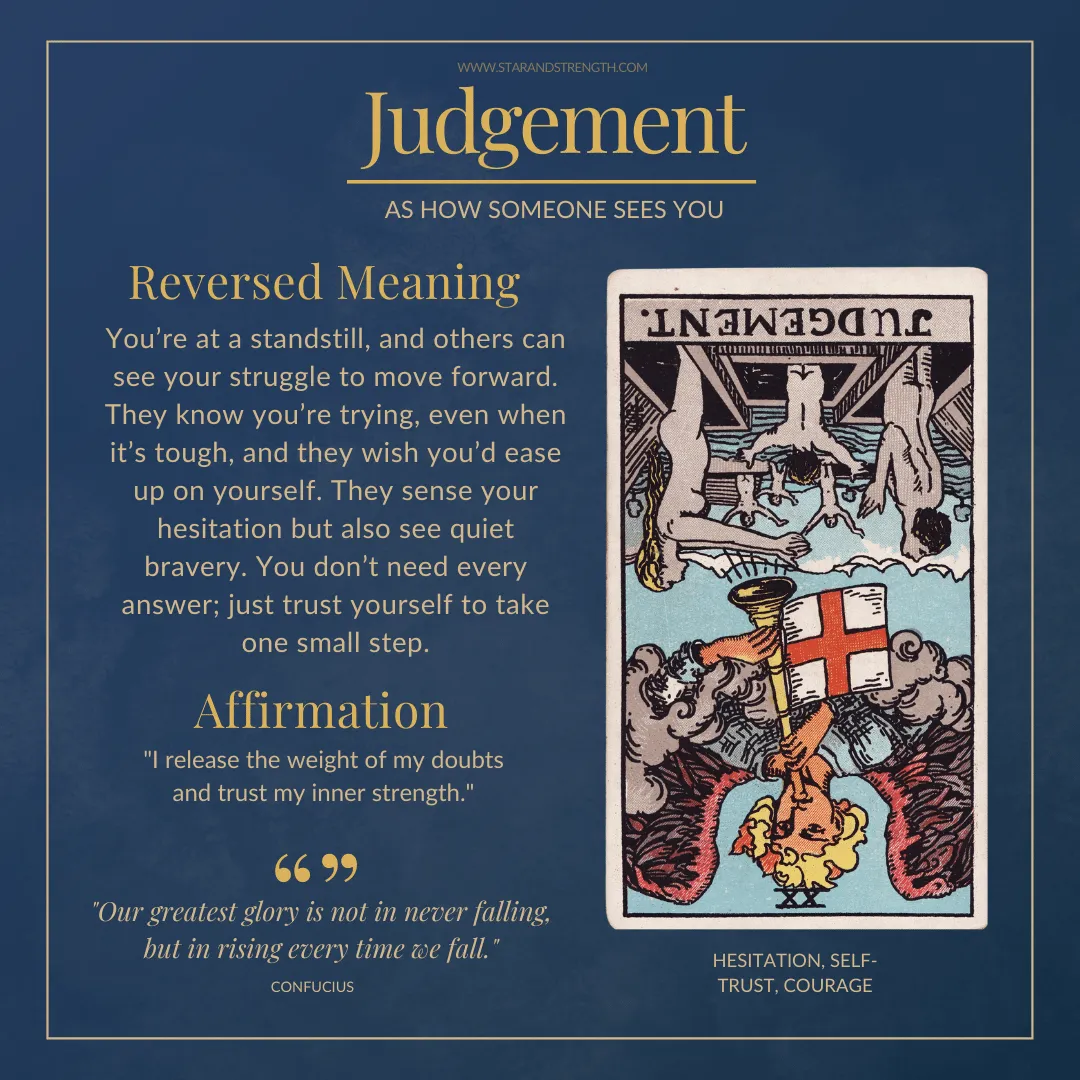
Almost on instinct, I reached for my deck. Shuffled it, cut it, and pulled a card. And there it was, staring back at me: Judgement Reversed. But this time, it wasn’t just words on a page from some dusty old book. It was a damn mirror. It was practically screaming: “Dude, you’ve been here countless times before! You know exactly what happens when you keep doing this. Why aren’t you listening to your own inner voice, the one that’s been trying to tell you to get your act together?”
That night wasn’t about “working” anymore. It was a full-blown battle. I tore apart my half-baked ideas, rebuilt them from scratch, scribbled notes until my hand cramped, and rehearsed my presentation in front of the mirror until my voice was hoarse. I made a solemn commitment right then: no more letting myself off the hook. This wasn’t about being perfect; it was about showing up, facing the music, and doing the work, even when it felt incredibly uncomfortable, even when that little voice in my head kept chirping “you’re not good enough.”
The next day, the event itself wasn’t flawless. I stumbled over a few words, my slides weren’t as polished as I’d have liked. But I did it. And more importantly, people genuinely responded well. But the biggest shift wasn’t external; it was internal. It was about recognizing that persistent, nagging pattern in my life – the avoidance, the self-sabotage, the endless stream of excuses. Judgement Reversed wasn’t some grand, cosmic verdict hanging over my head. It was about my own unwillingness to look at my own choices and finally take responsibility for them, to truly learn from the countless times I’d already walked down this exact, frustrating road.
After that raw experience, whenever I pulled Judgement Reversed, my entire approach changed. I stopped just reciting the generic meanings from the books. Instead, I would immediately ask myself: “What have I been avoiding? What lesson from the past am I actively refusing to see, right now? Where am I judging myself too harshly, or, conversely, where am I letting myself off the hook too easily, ignoring my own responsibility?”
I started really digging into the action it demanded. It wasn’t just a vague warning; it transformed into a very direct prompt. A prompt to pause, to deeply re-evaluate my current situation and my past behaviors, and then, crucially, to actually do something different. Sometimes, that meant swallowing my pride and admitting I was wrong, or that I had messed up big time. Sometimes, it meant finally facing uncomfortable truths about my own habits or choices. It meant forgiveness, yes, but that forgiveness only felt genuine after the honest self-assessment and the commitment to change, not before it.
I even started a simple journal, just bullet points, noting down the date I pulled Judgement Reversed and what specific ‘avoidance’ or ‘unlearned lesson’ I felt it was pointing to in that moment. And then, the most important part: I’d write down what concrete action I decided to take, no matter how small. Did I finally respond to that email I’d been dreading for days? Did I tackle that one persistent chore I kept putting off? Did I apologize for something I messed up? These small, deliberate actions started to build momentum, shifting that heavy, stuck feeling.
The card evolved from a confusing concept to an incredibly practical tool in my life. It became a powerful reminder that true clarity doesn’t come from passively waiting for external signs or some dramatic intervention. Instead, it comes from making those tough internal calls, from doing the often-uncomfortable work of self-reflection, and then acting on that insight. It’s about taking yourself off mute, truly listening to your own inner knowing – that quiet, persistent whisper of your own conscience – and finally, courageously moving forward with a renewed sense of purpose. It taught me that sometimes, the “divine call” isn’t some booming voice from the heavens; it’s the simple, steady urge from within, pushing you to get your act together and face what truly needs facing.