
Man, let me tell you, jumping into the world of Marseilles Tarot. That was a journey. For years, I mostly stuck with the usual decks, you know, the ones everyone starts with. But there was always this pull, this whisper about the Marseilles style, something older, rawer, more direct. I kept seeing bits and pieces online, folks talking about its history, its different way of communicating. And honestly, it intimidated me like crazy at first.
I remember just staring at images of those decks, especially the pip cards. No little story scenes like I was used to. Just a bunch of swords, cups, wands, and coins, all arranged in patterns. My brain just screamed, “What am I even supposed to do with this?” But that curiosity, it just wouldn’t let go. So, I finally decided to dive in, headfirst, and see what all the fuss was about.
My first move? I grabbed whatever cheap version I could find online. It was a mass-market reproduction, shiny, thin cardstock, and the colors felt… off. I opened it up, shuffled a few times, and just felt lost. The images didn’t speak to me. It felt like trying to read a language I didn’t know, with no dictionary. That deck sat on my shelf for a while, a symbol of my failed attempt. I thought maybe Marseilles wasn’t for me.
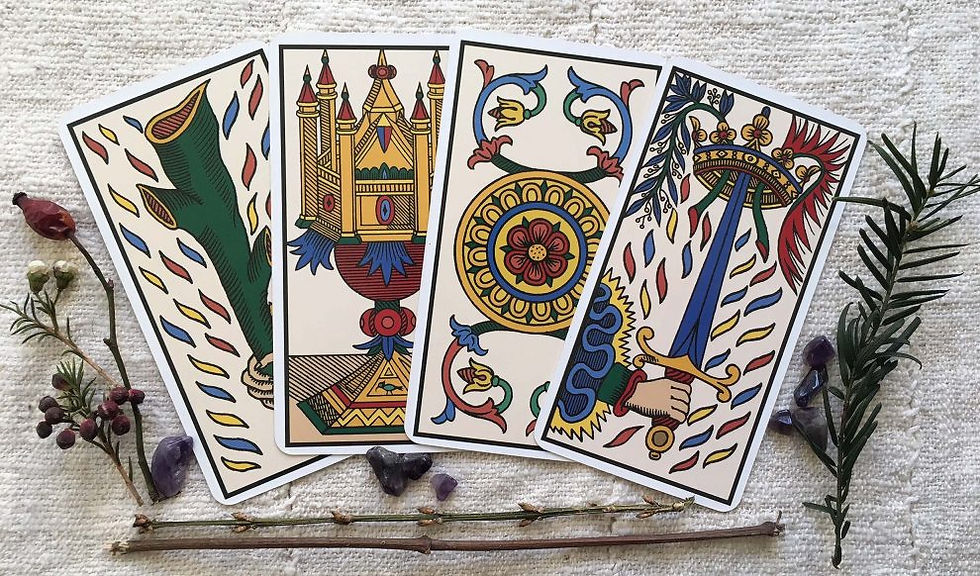
But then, a friend, who’d been using TdM (Tarot de Marseille) for ages, encouraged me. He said, “You gotta try a good one, man. It makes all the difference.” He lent me his deck, a really well-made restoration, and suddenly, everything shifted. The card stock felt solid in my hands, the colors were rich and deep, and the lines just popped. It was like looking at the same ancient text but finally seeing it in crisp, clear print. That’s when I realized: the quality of the deck itself can seriously impact your connection to it.
My Personal Yardsticks for Picking a Deck
After that lightbulb moment, I started being way more deliberate about picking decks. For me, it always comes down to a few things that really matter in a Marseilles deck, because they change how you interact with the cards.
- The “Feel” of the Art: Is it a restoration that feels authentic, like you’re holding something old and powerful? Or is it a modern interpretation that still respects the tradition but adds a fresh touch? I like both, but they serve different moods. I found myself drawn to decks that looked hand-drawn, a bit rustic, not too perfect.
- Color Palette: This might sound small, but it’s huge. Some decks use really vibrant, almost primary colors. Others are more muted, earthy, like old stained glass. I’ve got decks that fit both, depending on what kind of “energy” I’m looking for in a reading. The rich reds and deep blues really make a difference.
- Card Stock and Finish: You’re going to be shuffling these things a lot. Does it feel good in your hands? Is it too flimsy, too stiff, too slippery? I prefer a matte finish, not too glossy, something that feels substantial. If it bends too easily or slides off the table, it breaks the flow for me.
- Size Matters: Some of these traditional decks can be pretty big. My hands aren’t massive, so I’ve learned that a slightly smaller, more manageable size works best for shuffling and spreading. But sometimes, a larger deck really lets you sink into the details of the Major Arcana. It’s a trade-off.
My Go-To Picks (From Experience!)
So, after messing around with a bunch, here are a few types that have really clicked with me and became staples in my collection:
The “Authentic Vibe” Deck
There’s this one type, based on a classic 17th-century restoration. Man, holding this deck, it’s like you’re touching history. The lines are a bit rough, the colors are deep and sometimes uneven, just like the old woodcuts. This was one of the first ones that truly opened up the Marseilles system for me. When I laid out the pips, suddenly the patterns, the way they interacted, it just started making sense. It wasn’t about individual pictures anymore; it was about the whole arrangement, the flow. This deck became my teacher, really making me slow down and just see the cards for what they were, without relying on external stories.
The “Clear and Crisp” Deck
Then I stumbled upon another style, a really clean, sharp restoration that’s often talked about. This one, it’s like someone took all the messy bits of the old prints and made them perfectly legible without losing the soul. The colors are bright but still traditional, and every detail, even on the pip cards, just pops. This one became my go-to for times when I needed to really focus on clarity. It somehow made the patterns of the pips even more obvious, helping me pick out the subtle differences that I might miss on a more rustic deck. It’s like it strips away any confusion and just presents the pure essence of the card.
The “Deep Dive” Deck
And finally, there’s a particular restoration that many serious Marseilles folks swear by, often with some deep symbolic overlay. This one, wow. It’s not just a deck; it feels like a whole philosophy in card form. The art is powerful, almost primal. Using this one, I found myself going beyond just reading the cards; I was contemplating them. It pushes you to think about the deeper meanings, the connections between the numbers, the colors, the postures of the figures. This deck really made me appreciate the layers of meaning that can be packed into what look like simple images. It’s a bit more demanding, but man, the rewards are huge.
Honestly, my journey with Marseilles Tarot has been all about trying things out, seeing what resonates, and not being afraid to ditch a deck that just doesn’t work for me. It’s not about finding the “best” deck objectively, but about finding the one that speaks to you. You gotta feel it in your hands, look at the art, and see if it makes your intuition tingle a little. It’s a personal connection, and once you find that, the whole system just opens up.