
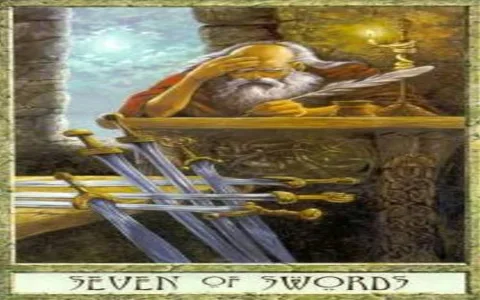
Man, I gotta tell ya, when that Seven of Swords popped up in my spread a while back, my stomach just did a flip. You know the one. That card with the dude sneaking away with a bunch of swords, leaving a couple behind. It usually screams ‘sneakiness,’ ‘deception,’ ‘someone’s trying to pull a fast one.’ My first thought? “Oh great, who’s screwing me over now?” Or even worse, “Am I the one being the jerk?”
I was in a real bind back then. Felt like I was constantly battling something. It was at work, actually. Big project, tight deadlines, everyone was stressed. I was putting in crazy hours, grinding it out, feeling like I was making some real headway. But then, things started to feel… off. Ideas I’d floated in casual conversations with certain colleagues would suddenly resurface in someone else’s presentation, slightly tweaked, just enough to not be exactly mine, but undeniably inspired by my initial thoughts. It was subtle, but it chipped away at me.
So, when I pulled that Seven of Swords, it felt like a slap in the face. My immediate gut reaction was to get mad, to confront someone, to point fingers. I pictured myself storming into a meeting, holding up the card, and shouting, “See?! This is what’s happening!” But then, I stopped myself. That’s not my style. And honestly, it wouldn’t solve anything. It would just make me look unhinged.

I sat there, just staring at the card for a good long while. The traditional meaning kept swirling: theft, trickery, getting away with something. But then I started to think about it differently. What if it wasn’t just about outright stealing? What if it was about strategy? About being clever? The guy in the card isn’t running away in a panic; he looks pretty deliberate. He picked his swords, and he’s moving on.
Rethinking the Game Plan
I remember thinking, “Okay, if someone’s being sneaky, how do I counter that without becoming a sneak myself, or just getting steamrolled?” I needed to learn from that sneaky energy, but for good, not evil. My first step was observation. I decided to pull back a bit, not share every single nascent idea I had. I started being more intentional about documenting my contributions. Not in an obvious, “look at me!” kind of way, but just for my own records.
- I started writing things down more often. Every idea, every suggestion, every draft I worked on, I saved it with a clear date and time. It sounds simple, but I often relied on verbal discussions, which, turns out, aren’t great for proof.
- I began to choose my confidantes more carefully. Instead of bouncing every new thought off anyone who’d listen, I narrowed it down to one or two trusted team members. People I knew had my back and weren’t in it for themselves.
- I focused on presenting finished work, not just raw ideas. Instead of just talking about a concept, I’d work it up a bit more, get it to a more solid stage, and then present it in a way that clearly showed my unique input.
It wasn’t about being paranoid, it was about being smart. Like the guy with the swords, I needed to pick my battles and secure my assets. I realized the card wasn’t just warning me about someone else; it was telling me to be more strategic, to protect my intellectual “property,” if you will.
Taking Action, Smartly
The biggest shift for me was in how I engaged in meetings. Instead of just throwing ideas out there and hoping they’d stick or be recognized, I started to frame my contributions differently. I’d tie my ideas back to previous discussions I had initiated, or even send a quick email summarizing my thoughts before a meeting, effectively timestamping my input.
And when a certain colleague tried to subtly re-present one of my ideas as his own, I didn’t get angry. I just calmly said something like, “That’s a great point, Greg. It builds nicely on the concept I outlined in my email from Tuesday regarding X.” No accusation, no drama, just a quiet, firm reclaiming of my intellectual ground. It was like I was wielding my own little sword, but not in an aggressive way, more like a precise little poke. It made him pause, and it made others in the room glance around, a little light dawning in their eyes.
The whole experience taught me a huge lesson. The Seven of Swords isn’t just about deceit; it’s also about cleverness. Sometimes, you gotta be a little cunning, a little strategic, to protect what’s yours or to navigate tricky situations. It’s not about being malicious, but about being aware and proactive. It pushed me to think about my own boundaries and how I was letting others cross them without even realizing it. It forced me to sharpen my own game, not just defensively, but in how I presented myself and my work. I started carrying myself with more confidence because I knew I was backing up my work with solid, traceable effort. It was a tough lesson, but man, it made me so much stronger in the long run.